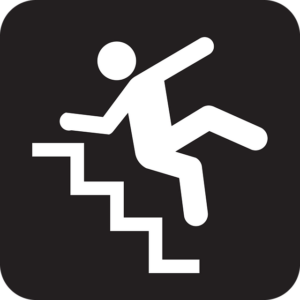
Nobody talks about this, but most falls on trail are completely preventable… and the fix has nothing to do with your boots or age or muscle mass. Balance is not a physical gift. It’s a practice.
During my first long-season as a Ridgerunner on the Appalachian Trail in the Smokies, I never fell. Not once. That was backpacking with a heavy backpack four days a week, for nine months… (Well, except for the two weeks I was off trail getting hammered by a hurricane, but who’s counting?) In my second long season, I fell three times on my second hitch. Same gnarly trail. Same legs. Same woman. So, what changed?
Everything and nothing. And that’s exactly the point.
IT BEGINS WITH HOW YOU CARRY YOURSELF
Body posture and alignment are the first variable, and the one most hikers completely overlook. Your center of gravity lives in your core and hips, and that’s where it matters most. If you’re out of alignment by even a small amount in your lower body and back, by the time that misalignment reaches your head, you’re off-kilter by quite a bit more. You’re essentially walking around with a stoop you can’t see but your ankles absolutely feel.
Think of it this way. When your weight is stacked vertically over your hips with your spine straight, shoulders over core, core over feet, your body moves as one balanced unit. Gravity works with you instead of against you. There’s less resistance, less compensation, less of your muscles working overtime to keep you from tipping in a direction you didn’t choose. But the moment that stack shifts, just a slight forward lean here and a slouch there, every step becomes a small movement of recovery instead of a purely fluid one. And on uneven terrain, those small recoveries are exactly where falls begin.
In my journey of understanding how I did everything 100% absolutely wrong when I first began hiking, backpacking, and later, running, the greatest lesson I have learned is about how I carry my physical presence while walking on trail… training myself to maintain a straight, aligned spine. Balancing my center of gravity. Always being vigilant about wearing shoes with proper support and tread. And becoming more mindful of the impact of each footfall… the relationship between my body and the ground it’s touching.
One of the simplest and most overlooked tools for maintaining that alignment is a good pair of trekking poles. They aren’t just for steep climbs or over-tired knees. Poles give you two additional points of contact with the ground at all times, dramatically improving your stability and balance, especially on uneven terrain, stream crossings, and descents. I consider them as essential as my boots when I am carrying a heavy backpack.
This isn’t complicated stuff. But it does require attention, and attention is exactly where most of us fall short. Literally.
THE REAL CULPRIT IS DISTRACTION
Whether it’s technical terrain, wet rocks, a potentially icy section, conversation with the company I’m keeping (whether in my mind, a tree, or another human!), or simply the breathtaking view competing for my attention… distraction is almost always involved when I go down.
I can tell you exactly what happened each and every time I’ve fallen, and especially every time I’ve sustained an injury on trail. There are always two things in common. I was going too fast, and I wasn’t paying attention. Every. Single. Time.
Mountain bikers have a saying… you go where you look. If you stare at the rock you’re trying to avoid, you will hit the rock. Every time. Your body follows your eyes, whether you’re careening down a mountain on two wheels or walking a rooty stretch of trail. The same principle applies. If your gaze is fixed on the hazard, or your mind is on the thing you’re afraid of, that’s exactly where your feet will take you. But when you look at where you want to go… the clear line, the solid footing, the smooth path through… your body follows. On trail and in life.
Early in my second Ridgerunning season, the trail was covered with wind damage from storms, trees and limbs everywhere. I kept trying to do trail maintenance without taking my pack off because there was just SO much of it. Hoisting a heavy winter pack up and down every few moments was exhausting, so I’d skip it. I started keeping my gloves and handsaw in a reachable pocket, which seemed brilliant until I found out the hard way that it was impractical, to say the least. (Lesson learned. Several times, apparently.)
WHAT YOU TELL YOURSELF MATTERS MORE THAN YOU THINK
In the beginning, when I was still new to hiking, I called myself clumsy. Frequently. And I genuinely created that reality for a while. Every stumble confirmed the story I was telling myself, and I found more and more reasons to believe it. I fell down nearly every time I hoisted a backpack!
In addition to staying present and mindful in the backcountry, and slowing to a pace that allows me to witness, in detail, what a magical place I’m exploring, there is a powerful mental component to not falling down. While there are certainly physiological issues that create imbalance, most of the time our sense of balance is purely a mental process. If we constantly affirm that we have terrible balance, that we are clumsy… so we shall be.
Balance is not something you either have or you don’t. It’s a skill, and like any skill, it responds to what you practice… including what you practice telling yourself.
And when I began regularly affirming something different… telling myself, I am balanced, I am always safe, I am centered, I flow down the path like water… I created that reality, too.
After all these years and all these miles, slowing down is not a byproduct of experience. It is the practice itself. When I slow down, I see the trail more clearly. I place my feet with intention. I notice the roots before they notice me. And something phenomenal happens… I see the equisite beauty I came out here to find in the first place.
I rarely fall now. (I dare not say never!) Not because I’ve become more athletic or because my boots got fancier. But because I stopped rushing, started paying attention, maintain good posture, and began telling myself a better story about who I am on trail.
That, it turns out, is the whole secret. And lo and behold, it works off trail, too.