
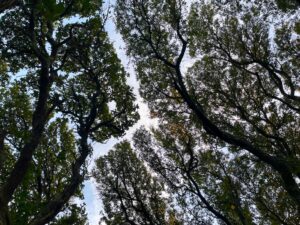
 Look up in a maritime forest where live oaks reign, and you might catch one of nature’s most elegant mysteries: crown shyness. There, against the sky, the canopy creates a living jigsaw puzzle—each tree’s leaves stopping just short of its neighbor’s, leaving luminous channels of light between them.
These trees are doing all their tree stuff—photosynthesizing, sheltering wildlife, standing firm against salty winds… while somehow maintaining the most courteous of boundaries. They grow toward the sun, stretch their limbs wide, and yet pause at an invisible line, as if they’ve agreed to respect each other’s space.
Scientists offer theories: maybe it’s wind-induced abrasion, the branches learning where friction occurs and pulling back. Perhaps it’s light optimization, each tree calculating where its neighbor begins. Some suggest it prevents disease and pests from spreading tree to tree, a kind of social distancing that predates our understanding by millennia.
But stand beneath those live oaks with their gnarled branches draped in moss, and it feels like something more—a quiet agreement written in wood and leaf. These ancient beings, connected underground through vast mycorrhizal networks, sharing resources and warnings, also know when to give space. They’re doing the most radical thing imaginable: thriving together by honoring where one ends and another begins.
The puzzle pieces of light shift with the breeze, the gaps hold steady, and the trees teach us something we keep forgetting: boundaries aren’t barriers to community… Sometimes they’re exactly what makes it possible.